The climb, as an exhibit
Built with AI assistance in the code; the design, decisions, and testing are the author's.
Built with three.js, React Three Fiber, React, Astro, Blender
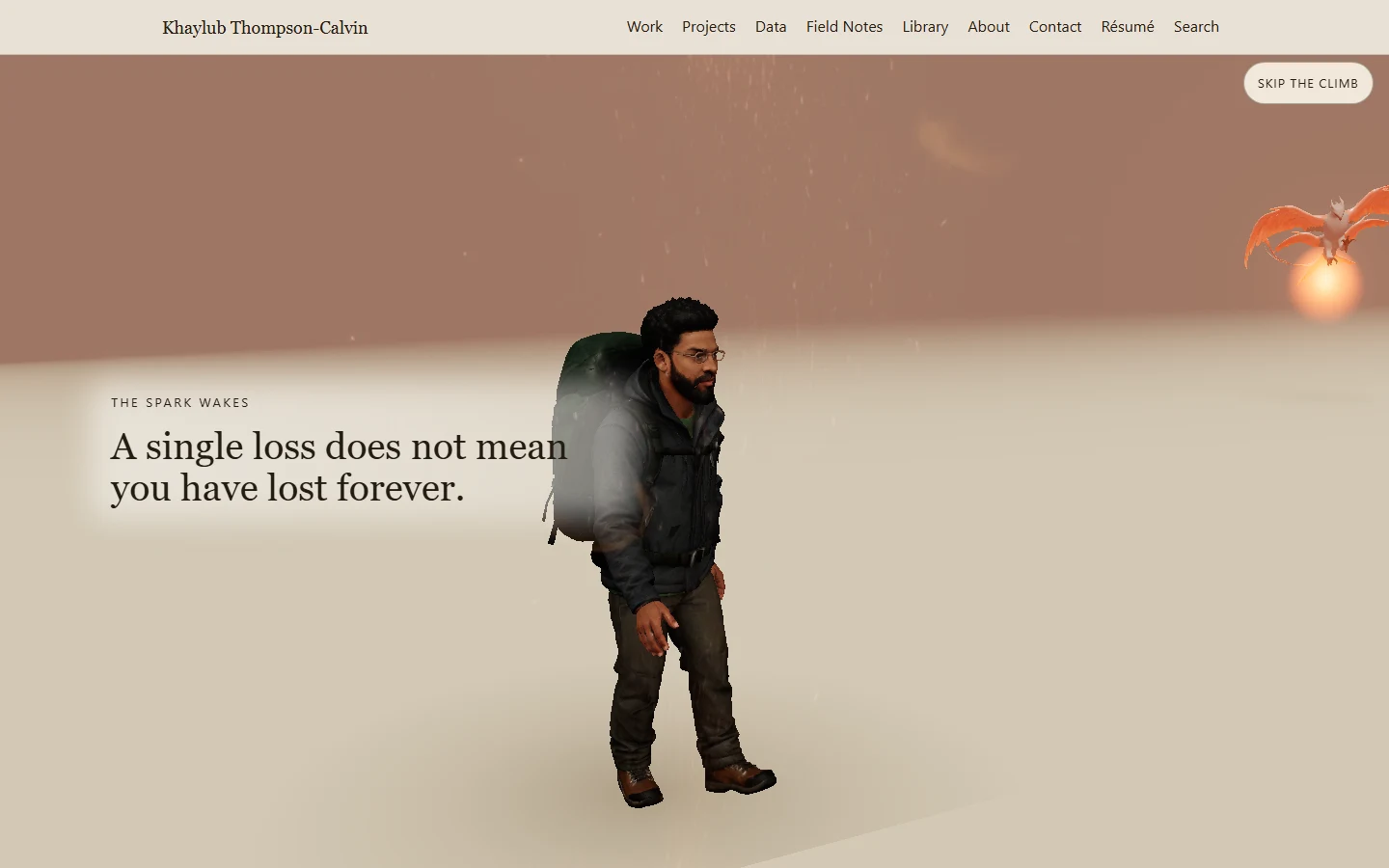
What it is
The scene that launched as khaylub.com on 2026-06-24 and still serves the public domain (this
site takes over only at a later phase), kept as it shipped at tag v1.0.0-3d-experiment and
ported into this site as an island: the Wanderer walking from
night into day, the Phoenix igniting at the midpoint and filling the sky at the summit, the same
models and camera choreography, the same six beats, the words as shipped (except the availability
line, which is this site’s), and the atmosphere plates re-encoded. What the port leaves out is
listed under “What changed in the port”. It opens from “Enter the climb” on
the home page or from “Tap to explore” on its own page, and nothing from it downloads
before that press.
What loads, and when
Before the press: nothing from the climb, on any page (a test asserts zero such requests on the
home page and the climb page). After the press, measured on 2026-09-12 with Playwright over one
full scroll (scripts/capture-climb.mjs): 7.36 MB in total (7,355,051 bytes, served uncompressed
by the local test server), made of the island’s code (1.02 MB), its React runtime (0.19 MB), its
stylesheet (9 KB), the two models (the Wanderer 1.82 MB and the Phoenix 0.92 MB), and the four
atmosphere plates (fog 1.32 MB, dawn grass 0.69 MB, embers 0.76 MB, summit clouds 0.62 MB). The
two plates that belong to later beats are fetched only as you approach them. For comparison,
the first version requested 14.5 MB across thirteen files before its gate could be tapped
(The 16 MB front door).
What changed in the port
- The scene, models, plates, camera, beats, and copy are the first version’s. The plates were re-encoded to this site’s video rules (H.264 CRF 23, capped at 5 Mbps, no audio track), which took the four from 19.06 MB to 3.39 MB (file sizes on disk) without changing their length or resolution.
- Scrolling is the browser’s own; the first version’s smooth-scroll library is not included, so the page around the climb behaves like every other page here.
- The five concept-film cards of the Camps beat are not included: the films and their posters have no recorded generator or terms yet, and this site publishes no media without a record. Their cards remain as narrative; two link to project pages, three say plainly that they are concepts.
- The far mountain vista of the summit is not included for the same reason; the distant ridges you see are drawn procedurally.
- The first version’s own header, entry gate, and case-study dialogs are replaced by this site’s header, door, and project pages; the availability line is this site’s one statement.
How to use it
Scroll to walk. Near the summit the cursor steers the Phoenix and fans its fire. “Skip the climb” stays visible at the top of the island and returns you to the door; the Tab key reaches it and every link in the climb. With reduced motion set in your system, the plates stay paused and hidden, the copy is solid instead of revealing, and the models still load because you asked for them.
Where the assets come from
The Wanderer and the Phoenix began as Tripo generations and were finished in Blender by the
author; the four plates were generated with Higgsfield from the author’s prompts. Each file under
public/climb/ has an entry in public/climb/provenance.yaml, and the build fails if one is
missing.
Credits and process
- Source
- The author's own screenshot of the ported climb on this site (the Spark Wakes beat at 1440 by 900), taken with Playwright on 2026-09-12. The scene contains the Wanderer and the Phoenix (Tripo base meshes finished in Blender by the author) and a Higgsfield atmosphere plate, each recorded in public/climb/provenance.yaml.
- Generated in part with
- Tripo and Higgsfield for the assets in frame, as recorded; the screenshot itself is a plain capture
- License
- All rights reserved; the author's own screenshot of the author's own site
- Date
- Process
- Built with AI assistance in the code; the design, decisions, and testing are the author's.